

Article: KELP FOREST LIMITED EDITION
KELP FOREST LIMITED EDITION
Oris returns to ocean conservation with a 1,000-piece version of the Aquis Date 41.50 mm dive watch inspired by the magisterial beauty of kelp forests
IT’S TIME TO TALK ABOUT KELP

Kelp forests absorb carbon and provide the world with oxygen. But overharvesting and rising ocean temperatures have seen their numbers decline Kelp is fascinating. The giant seaweed can grow up to 60 cm (two feet) in a day. It’s a carbon capture hero and produces as much as 2 per cent of the world’s oxygen. When it multiplies into kelp forests it becomes a natural wave break to mitigate for coastal erosion and even tsunamis. And it provides shelter and food for fish, invertebrates and marine mammals.
But as the world’s ocean water temperatures rise and as they’re overharvested, kelp forests have come under threat. One NASA study showed kelp forests off the coast of California have collapsed, while scientists in Spain established that 58 per cent of the kelp forests off the country's north-west coast have disappeared over the past 25 years.
What can we do? At Oris, we’ve been working with our partners for decades to raise awareness of climate change, with a specific focus on ocean conservation. Water is the source of life, and we believe we all have a role to play in arresting the effects of global warming and the degradation of the marine habitats and species that sustain our planet. We’re not alone. Thousands of Oris fans have invested in our limited-edition conservation watches and contributed to shared goals.
Change only comes when we work together. And now, the Kelp Forest Limited Edition. This 1,000-piece version of our high-performance, evergreen Aquis ate 41.50 mm was conceived after a conversation with our long-time friend and ambassador Francis Pérez. Francis has won numerous awards for his underwater photography. We’ve often used his World Press Photo award-winning image of a loggerhead sea turtle entangled in a ghost fishing net. In a career stretching back more than 25 years, he’s seen the world’s kelp forests decline and so he encouraged us to help tell the story. When Francis speaks, we listen, and so it’s our duty and our joy to present the Kelp Forest Limited Edition.

"KELP IS A CARBON CAPTURE HERO. BUT IT’S UNDER THREAT"

GOING BELOW THE SURFACE
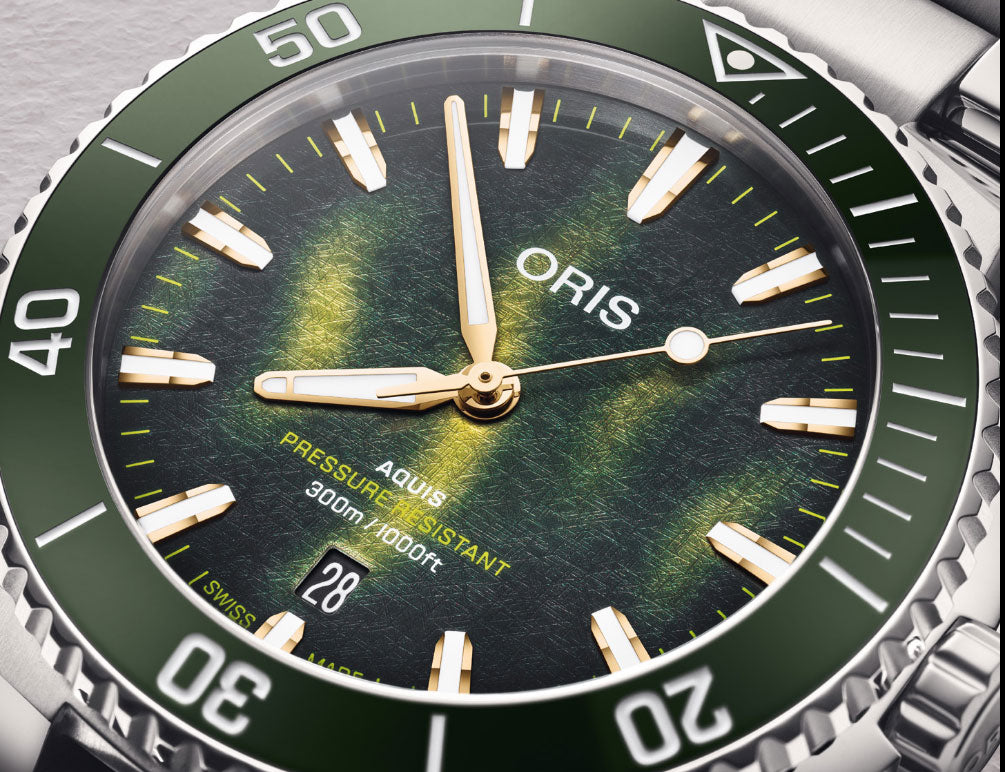
The new Kelp Forest Limited Edition is based on the Aquis Date dive watch and features a special ocean green dial that shimmers like waving kelp
It’s a great joy to return to the oceans and to introduce the Oris Kelp Forest Limited Edition. This 1,000-piece version of the Aquis Date 41.50 mm is the next chapter in our decades-long mission to conserve marine ecosystems and raise awareness of the role the world’s oceans play in helping to mitigate climate change. The new watch shares its basic architecture with our high-performance Aquis Date 41.50mm dive watch. But the story of this particular watch is in its dial. To create an effect that echoes the languid beauty of kelp as it sways in underwater currents, we 3D-printed a surface finish that gives it both texture and the green and gold colour variation found in kelp forests. This theme continues in the golden outline applied to the lumed hands and hour
markers. As it catches the light, the dial appears to move as if submerged in water, a dazzling effect.
The Kelp Forest Limited Edition’s case is in stainless steel and water-resistant to 30 bar (300 metres). This is complemented by a uni-directional rotating bezel with a green ceramic insert and minutes scale for timing dives, as well as a screw-in security crown with protection. It sits on an elegantly tapered stainless steel three- link bracelet with brushed and polished surfaces. For ease-of-use, the folding clasp is equipped with quick adjust and quick change systems. Inside, the watch beats to the rhythm of Oris Calibre 733, a Swiss Made three-hand automatic with a date function and a 41-hour power reserve. The case back is engraved with a kelp motif and the limited-edition number.
Behind this watch, there’s an important story of conservation,” says Oris ambassador and award-winning underwater photographer Francis Pérez, who speaks to us about kelp’s role in conserving the world’s oxygen levels on page 6. ”I believe it’s going to generate a great deal of conversation.”
"THE DIAL ECHOES THE LANGUID BEAUTY OF SWAYING KELP"

THE BLUE FOREST
Oris ambassador and underwater photographer Francis Pérez is a World Press Photo winner. Here, he explains how kelp forests sustain all life on Earth.
Francis, great speaking with you. Tell us a bit about yourself... I’m Francis Pérez from Tenerife, in the Canary Islands, Spain. I’m an economist and a professional underwater photographer. I’ve been diving for 30-plus years and photographing the oceans for around 25.
What motivated you to get into underwater photography and what story do you want to tell through the images you capture? It started with growing up in the Canary Islands and living so close to the sea. Maybe five years after I started diving, I began to feel the need to show other people everything.
I was seeing underwater. It’s a joy to take people into the depths and show them the natural history of the ocean, its beauty and its fragility. When did you partner with Oris? It was in 2015 when I was invited to take underwater photographs for the launch of Oris’s El Hierro Limited Edition. There I met the Oris Spain team and Claudine [Gertiser-Herzog, now Oris vice-chairwoman], and we spent some incredible days together.
Shortly afterwards, Oris Spain contacted me to become the director and organiser of an exhibition in Madrid celebrating 10 years of Oris’s commitment to ocean conservation.
KELP FORESTS ABSORB CARBON AND ARE VITAL IN HELPING TO MITIGATE CLIMATE CHANGE
Watches such as the El Hierro, the Hammerhead, the Great Barrier Reef and Staghorn Coral editions were exhibited. It was spectacular. That was when they offered me the opportunity to become a national ambassador. I remember they gave me an Aquis Regulateur Der Meistertaucher — a beautiful watch.
Now, you’re bringing the story of kelp forests into focus. What are kelp forests and where do they occur?
A kelp forest is an underwater ecosystem formed by dense populations of large algae, which can grow to more than 30 metres in length. They grow from the rocky seabed all the way to the surface, resembling forests on land.
They’re found in temperate and cold waters around the world and are particularly abundant in California and along the coasts of Chile and Peru, extending as far south as Patagonia. They can also be found in South Africa, New Zealand, Australia and other parts of the world.
What role do they play in nature?
They’re among the planet’s most productive habitats, providing shelter and food for fish, invertebrates and marine mammals. They also absorb large amounts of carbon, making them vital in helping to mitigate the effects of climate change.
They make an essential contribution to oxygen produced by the ocean (around 1 to 2 per cent of the world’s total). And they’re also ecosystem engineers, acting as natural barriers against tsunamis and storm surges.
And why tell the story now — are they endangered?
Until quite recently, kelp was collected by fishermen and beach harvesters. But today it’s being removed from the seabed by its roots. The term “underwater deforestation” is already being used to describe what’s happening. Chile, Canada and Norway are among the major harvesting countries and global suppliers. The kelp forests of Chile are among the most degraded in the world. The picture is changing fast and the time to highlight the threat is now.
What’s causing their decline?
Commercial demand is a major factor, particularly for the extraction of alginate, which is used as a thickening and gelling agent to improve the texture of desserts, ice cream, dairy products and sauces. It’s also widely used in the textile, pharmaceutical and agriculture industries.
How will this new Oris project help reverse underwater deforestation?
Critically, by bringing attention to this wonderful refuge for biodiversity and raising awareness of a problem very few people know about. Underwater deforestation is real.
What do you think of the watch, the Kelp Forest Limited Edition?
It’s a wonderful watch, and behind it there is an important story of conservation. I believe it’s going to generate a great deal of conversation.
We’ve featured a lot of your work, but the image that really stands out is of a turtle entangled in ghost fishing net. Some days, the job must be heartbreaking?
yes, increasingly so. I don’t go out to sea to photograph the destruction we are causing; I go out to photograph its beauty. Unfortunately, however, I often come across very sad situations that are difficult to forget, and I feel a responsibility to tell those stories.
Working on and under the water can be unpredictable — have you ever had any “scary” moments?
Yes, a few. But never because of the animals that live in the ocean — always because of the ocean itself. Strong currents that can carry you away from the boat or the shore, powerful winds... Those are the moments that can be frightening.
We hear so much about climate change and most of the focus is on Help for kelp Francis Pérez’s spectacular imagery captures the beauty of the underwater world – and the need to conserve it.

how it’s impacting human life. How is it impacting the oceans?
One of the most dramatic changes is the increase in water temperature. This has caused, for example, coral bleaching to begin occurring in some parts of the world. That’s another very serious issue and one that could lead to a very broad discussion. It’s deeply sad. Coral bleaching is something that causes me great concern.
It’s a big question, but why do these changes pose such a serious challenge to life on Earth?
Because life on Earth has developed under certain physical and chemical conditions, and altering those
conditions could make life impossible. For example, destroying organisms and ecosystems that produce oxygen and capture carbon, such as kelp forests, has profound consequencesfor the planet.
Another big question — what can be done to solve it?
First, we have to recognise that we have a problem. Second, we have to convince decision-makers that we have a problem. And, fundamentally, we need to listen to science.
And besides buying the watch, how can people get involved in kelp conservation efforts?
There are many local and international organisations working to protect kelp forests. We can support them, listen to them, help spread their message and support their campaigns by signing petitions. At the same time, we can make more responsible choices as consumers. And this is the difficult part, because making responsible choices requires information — and that information is not always available, especially when there are interests that would rather keep it from us.
KELP FOREST LIMITED EDITION
Based on the Aquis Date, this high-performance dive watch tells the story of giant kelp forests through its shimmering green dial

IN DETAIL
Case Multi-piece stainless steel case, uni-directional rotating bezel with ceramic insert and minutes scale
Size 41.50 mm
Thickness 12.90 mm
Lug to lug 49.00 mm
Dial Ocean green with light green kelp forest 3D-print
Luminous material Hands and indices filled with Super-LumiNova®
Top glass Sapphire, domed on both sides, anti-reflective coating inside
Case back Stainless steel, screwed, special engravings
Operating devices Stainless steel screw-in security crown
Bracelet Multi-piece stainless steel metal bracelet with folding clasp, with quick adjust and quick change systems
Water resistance 30 bar (300 m)
MOVEMENT
Number Oris Calibre 733
Functions Centre hands for hours, minutes and seconds, date window, instantaneous date, date corrector, fine timing device and stop-second
Winding Automatic
Power reserve 41 hours
Limited edition 1,000 pieces
Swiss retail price CHF 2’450
Availability October